




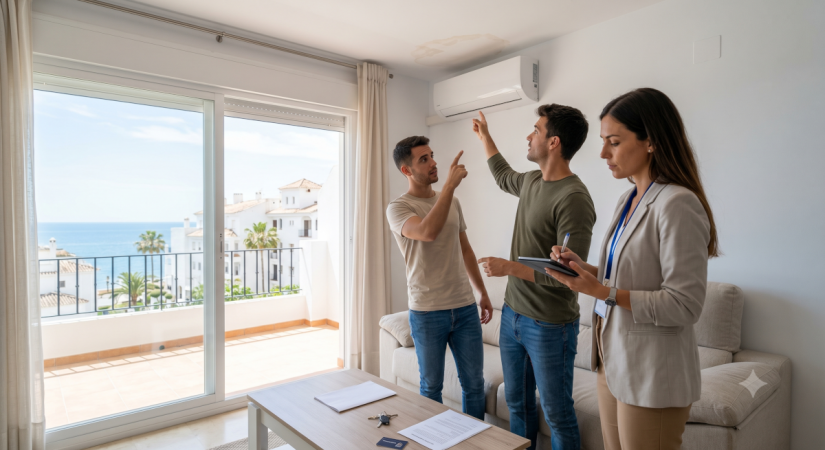
The boiler breaks down. Moisture appears on the ceiling. The bathroom tap is leaking. When something fails in a rented apartment, the first question that always arises is the same: who has to pay for it? The answer is not always obvious and that ambiguity is the root of some of the most frequent conflicts between landlords and tenants in Spain.
In most cases, the key is in the origin of the damage: if the breakdown is a consequence of natural wear and tear or a structural problem, responsibility falls on the landlord. If it derives from daily use or negligence, it corresponds to the tenant. But between one extreme and the other there is a gray area that is worth knowing well before taking action.
👉 Want to know if a landlord can enter a rented property and what rights a tenant has? Read our full article and find out what the law says.
What the law says about repairs in a rental
The legal framework that regulates this matter in Spain is the Urban Lease Law (LAU). Its article 21 establishes the general principle: the landlord is obliged to carry out all necessary repairs to keep the dwelling in habitable conditions, except when the deterioration is attributable to the tenant.
The same article contains the counterpart: small repairs required by ordinary wear and tear of the dwelling are the responsibility of the tenant.
This distinction between maintenance repairs and small repairs is the axis on which the entire distribution of responsibilities turns. When there is doubt about which of the two groups a specific breakdown falls into, case law also resorts to article 1563 of the Civil Code, which establishes a presumption of tenant liability: whoever occupies the dwelling is responsible for the deterioration unless they prove otherwise.
👉 Would you like to learn more about the taxes when selling a property in Andalusia as a non-resident? Read our article to understand the taxes and expenses you should consider before completing the sale.
Repairs the landlord must pay for: which fixes correspond to the landlord
The landlord must assume everything necessary for the dwelling to be inhabited normally. These repairs cannot be passed on to the tenant through the rental price nor justify a rent increase.
These are the landlord’s responsibility, including:
- Plumbing, electrical and gas installations: breakdowns due to age or structural wear, not caused by the tenant.
- Structural elements: floors, ceilings, facades, roofs, downpipes. If the damage affects the property itself, the general rule is that the landlord pays.
- Moisture and leaks: when they have a structural origin or come from the building, they are the responsibility of the landlord.
- Appliances included in the contract: if the apartment was rented furnished with a washing machine, dishwasher or other appliances, the landlord must repair or replace them when they fail due to age or manufacturing defect.
- Boiler and water heater: the repair corresponds to the landlord unless the damage is attributable to proven misuse.
A practical criterion: if the repair affects the property as a structure and not movable goods for daily use, it is usually the landlord’s responsibility.
Repairs the tenant must pay for: what the person living in the apartment must assume
The tenant is responsible for small repairs resulting from the daily use of the dwelling. The LAU does not set an exact amount to define what is “small”: it is case law that has been building interpretive criteria. The courts have recurrently used an approximate reference of 150 euros, although there are judgments that instead apply the criterion of 50% of the replacement value of the item. In practice, the amount is only one of the factors: the origin of the damage and the type of element affected also matter.
Repairs typically the responsibility of the tenant:
- Burnt-out light bulbs.
- Faucets or cisterns that leak from wear and tear.
- Blinds and locks broken from regular use.
- Small defects in furniture included in the dwelling, caused by accident or misuse.
- Appliance filters and basic maintenance (cleaning washing machine filters, extractor, etc.).
- Damage caused by misuse: any breakdown that the tenant has caused through improper use, regardless of the amount, is their responsibility.
If the tenant detects a breakdown and does not report it to the landlord, damage resulting from that failure can also fall on the tenant, even if the original cause was beyond their conduct.
Special cases and doubtful situations
Some situations don’t fit neatly into either category and generate the most common disputes.
Appliances: it depends on the cause of the failure
If the washing machine breaks due to age or defect, the landlord pays. If the damage is due to misuse, the tenant assumes it. When there is doubt about the cause, it is advisable to request a technical report before taking action.
Boiler: maintenance vs breakdown
The mandatory annual maintenance of the boiler is usually considered an obligation of the tenant, as it is part of the proper use of the property. The repair of a serious breakdown or the replacement of the unit at the end of its useful life corresponds to the landlord.
Moisture and leaks: the origin determines everything
A structural leak or one coming from an upper floor is the landlord’s responsibility. If moisture appears because the tenant does not ventilate adequately, responsibility can be reversed. Documenting the condition of the dwelling at the time of delivery, with dated photographs, is the best way to avoid disputes about this.
Age of installations
When an installation fails simply because it has reached the end of its useful life, the repair corresponds to the landlord even if the tenant has used it normally. Age does not make the breakdown the tenant’s responsibility.
How to manage a repair without it turning into conflict
Most conflicts between landlords and tenants over repairs are not born from bad faith, but from failing to establish the rules from the beginning.
Always communicate in writing
The tenant must notify the landlord of any breakdown in a reliable manner, preferably by certified mail or registered letter. A verbal communication or WhatsApp message may not be sufficient if the matter reaches a court.
Review the contract before acting
Many contracts include specific clauses that expand or clarify legal obligations. What is agreed upon always prevails provided it does not harm the minimum rights recognized by the LAU. If there is doubt about the interpretation of any clause, the most prudent course is to consult with a professional before carrying out the repair at your own expense.
Do not deduct repairs from rent without prior agreement
The tenant can only pass on the cost of an urgent repair to the rent if the landlord has expressly authorized that compensation in writing. Doing so unilaterally can be interpreted as partial non-payment. If the landlord refuses to carry out a repair necessary for habitability, the tenant can claim in writing and even, in serious cases, terminate the lease agreement.
Landlords in Estepona: why professional management makes the difference
The rental market in Estepona and the Costa del Sol has a particularity that amplifies the risk of conflicts: a significant proportion of tenants are international profiles unfamiliar with the Spanish legal framework. In that context, a poorly drafted contract or poorly managed communication can turn a minor breakdown into a prolonged problem.
Having an agency that manages the rental comprehensively changes the situation: the contract includes maintenance and repair clauses from the start, incidents are channeled through a clear protocol, and neither party is left unprotected when an unexpected situation arises.
At Cabanillas Real Estate we have been managing rental contracts in Estepona and the Costa del Sol for over 65 years. If you have a rental property and want to prevent a poorly managed breakdown from turning into a conflict, contact our team. We will assess your situation and advise you on the most appropriate contractual terms.

Si tienes consultas puedes contactar en sales@cabanillasrealestate.com
- Urban Planning Risks Before Buying Land in Andalusia - September 15, 2026
- What nobody explains about buying a house in Spain as a foreigner - July 21, 2026
- Taxes When Selling a Property in Andalusia as a Non-Resident - July 14, 2026
