





In recent months, short-term rentals have expanded rapidly in Spain, and particularly on the Costa del Sol, driven by tourism and the profitability they offer.
However, this situation has caused tensions within homeowners’ associations due to coexistence issues and rising housing costs. Under these circumstances, the recent regulatory reforms to the Horizontal Property Law provide that the homeowners’ association may prohibit tourist apartments.
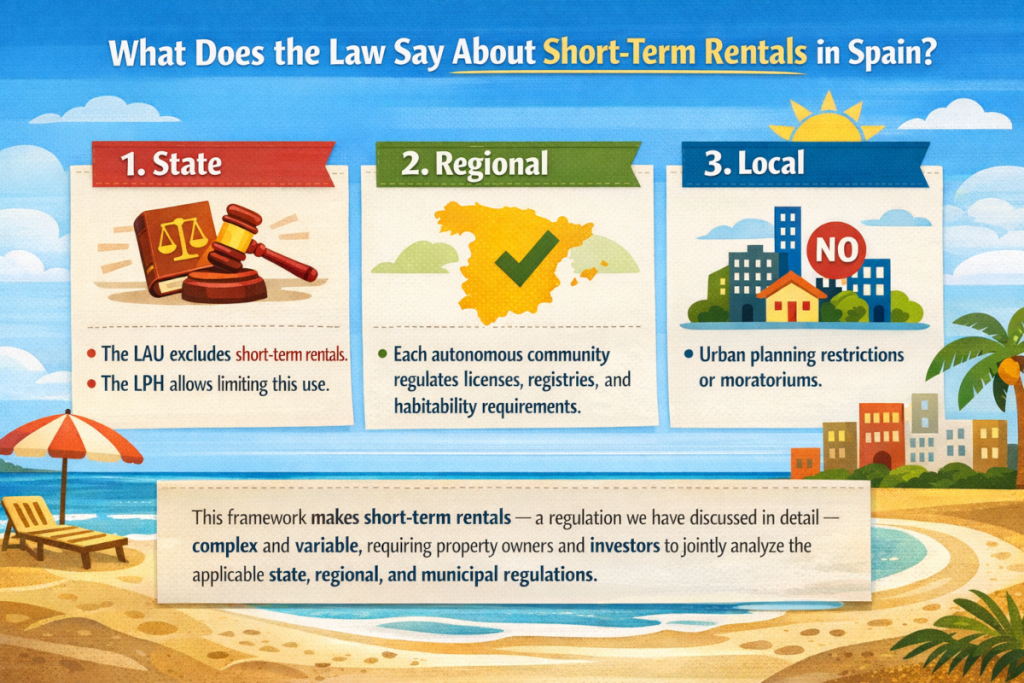
What does the law say about short-term rentals in Spain?
Regarding the legal framework, the law on tourist apartments in Spain is structured at three levels.
- National: The Urban Leases Act (LAU) excludes short-term rentals from its scope, while the Horizontal Property Law allows homeowners’ associations to limit this use.
- Regional: Each autonomous community regulates requirements such as licenses, guest registrations, and habitability conditions.
- Local: City councils may impose planning restrictions or moratoriums. This framework makes short-term rentals—a regulatory area we have discussed in detail—complex and variable, requiring property owners and investors to jointly analyze the applicable national, regional, and municipal regulations.
New short-term rental law and recent changes
Since April 2025, the Horizontal Property Law requires approval by three-fifths of the homeowners’ association to allocate a property to short-term rental use. In addition, since July 2025 it has been mandatory to register in the National Single Registry, obtaining an identification code that must appear on all online platforms to avoid penalties.
Tourist apartments: current regulations and legal requirements
To legally register a tourist apartment, short-term rental regulations require compliance with several levels of requirements.
At the national level, it is mandatory to register the property in the official registry and obtain an identification number that must appear in all listings.
At the regional level, a tourist license or registration is required to certify habitability, safety, and liability insurance. Municipal ordinances must also be complied with.
Can the homeowners’ association prohibit short-term rentals?
Yes. The homeowners’ association can prohibit short-term rentals through an agreement supported by three-fifths of the owners and ownership shares. However, it cannot prohibit seasonal or non-tourist rentals without unanimity, as this affects the right to use the property.
It is a fact that the homeowners’ association may prohibit tourist apartments, but in light of this statement, it is necessary to analyze the type of rental and the validity of the community’s agreement.
Cases in which short-term rentals can be prohibited
In response to the question, Can tourist apartments be prohibited? The answer is yes, in several legal situations.
- Through a resolution adopted at a meeting by a three-fifths majority.
- If the community bylaws already include such a prohibition or limitation.
- By amending the existing bylaws, bearing in mind that to prohibit non-tourist uses, unanimity is required.
In short, prohibiting tourist apartments in a homeowners’ association is valid as long as the legally required majorities are respected and properly recorded in community resolutions or bylaws.
Tourist apartment without the community’s permission: what happens?
Renting out a tourist apartment without the community’s permission can lead to significant consequences. First, the owner may face legal cease-and-desist actions, liability for legal costs, and administrative penalties that may include the withdrawal of licenses. In addition, conflicts due to noise or frequent guest turnover can harm coexistence and, therefore, the property’s value.
Case law and Supreme Court rulings on tourist apartments
Regarding the Spanish Supreme Court and tourist apartments, it has established clear precedents. In rulings from 2023, it upheld the cessation of short-term rentals in communities whose bylaws prohibited economic activities, considering that tourist apartments have a business nature.
Subsequently, in October 2024, a Supreme Court ruling on tourist apartments confirmed that a community could completely prohibit them through an agreement approved by a three-fifths majority, without requiring unanimity, clarifying that “limiting” includes prohibiting.
More recently, it stated that the prohibition must be express and clearly stated in the bylaws.
How to avoid conflicts over tourist apartments in a homeowners’ association
To rent a property on a short-term basis, it is essential for owners to be aware of the current regulations, review the community bylaws, and obtain all mandatory licenses and registrations.
From a coexistence standpoint, in response to the question of how to avoid problematic tourist apartments, the key lies in establishing clear rules for guests, limiting occupancy, appointing a local contact person, and maintaining good communication with neighbors, thereby reducing tensions and legal risks.
Recommendations for owners who want to rent legally
For owners who want to rent legally and avoid conflicts, the first step is to verify the short-term rental regulations and check whether the community bylaws allow such use. It is also essential to obtain the required licenses and registrations.
In this context, seeking legal advice is key: a specialized professional can confirm the feasibility of the rental, prevent administrative errors, and avoid penalties or litigation that could put the investment at risk.
Impact of the prohibition of short-term rentals on real estate investment
The restrictions recently introduced alter the traditional appeal of profitability from short-term rentals in Estepona and the Costa del Sol. The risks linked to community decisions and stricter regulations reduce income predictability and may negatively impact investment valuations if proper advice is not sought.
A specialized professional can thoroughly analyze the regulations and the profile of the community before investing, or explore alternatives and strategies adapted to this new framework.
Importance of working with a real estate agency in Estepona to manage properties
Having a real estate agency in Estepona, such as Cabanillas Real Estate, is essential in a complex regulatory scenario like that of short-term rentals.
A local agency facilitates informed decision-making: it can provide guidance throughout the process of obtaining licenses and registrations, reducing risks and common mistakes. The importance of working with a real estate agency lies in its technical and strategic support role, providing legal certainty and foresight for both property owners and investors.
Conclusions
In summary, in Estepona, a homeowners’ association may prohibit or limit short-term rentals when it is validly agreed at a meeting by a three-fifths majority, or when there is an express prohibition in the community bylaws.
This framework makes it essential to understand the current regulations—national, regional, and local—and to always review the bylaws before buying or renting for short-term purposes.
Therefore, in a market whose complexity requires thorough technical analysis, having expert advice from a local real estate agency such as Cabanillas Real Estate makes it possible to comply with the law, optimize property profitability, and manage guests safely and efficiently.

Si tienes consultas puedes contactar en sales@cabanillasrealestate.com
- Guest registration in SES Hospedajes: requirements and obligations - March 4, 2026
- Can a homeowners’ association prohibit short-term rentals? - February 24, 2026
- Requirements for tourist housing: complete guide - February 3, 2026